Journal
What to wear for a headshot, and what to bring in the bag
Plain beats patterned, a collar beats a crew neck, and the second shirt matters more than the first. A studio's list, in the order it gets used.
Wear a plain top with a collar, in a solid color clearly darker or lighter than the backdrop, and make sure it fits at the shoulders. Then bring a second one that differs from the first in more than color. That is most of the answer.
The rest is reasoning, because a headshot is an unusual photograph: a close crop of the face, the neckline and the top of the shoulders, often cut again to a small circle on a LinkedIn profile or a staff page. Everything below the collarbone becomes a shape, so the few choices that remain matter more than they would anywhere else. The list of what goes in the bag is near the end, in the order it gets used.
Plain beats patterned
A fine pattern — narrow stripes, small checks, a tight herringbone — can break into a shimmer of false color in a digital photograph. The effect is called moiré. It happens when the spacing of the weave is close to the spacing of the camera's sensor, and at headshot distance a shirt is exactly the wrong size. It can be softened afterward, but it rarely disappears, and softening it photograph by photograph is slow.
A bold print does the opposite damage: it photographs perfectly well and then looks louder than the face above it. Logos and lettering are the third problem, because the eye reads words before it reads a face, and because a headshot tends to be used for years. Solid colors in middle and deep tones — navy, charcoal, forest green, a muted blue, burgundy — photograph calmly on most people.
Mind the backdrop as well. White against white paper, or black against black, loses the line of your shoulders; the photographer can light around it, but it is easier not to need to, so if you are unsure, ask which backdrop your session will use when you book. Matte fabric photographs more quietly than shiny fabric, which throws small highlights back at every light. And linen creases the moment you sit down.
A collar, and what sits under it
A collar frames a face. It draws two lines up toward the jaw and gives the bottom of the photograph a structure a crew neck does not, which is why a collared shirt or a jacket reads as professional even when the photograph shows only the top of it.
A crew neck is not wrong. It is the right choice for an actor who is sent out for relaxed parts, or for anyone whose work is not done in a jacket. But in a tight crop it shortens the neck and makes the photograph more casual than most people intend. A V-neck or an open collar lengthens the line; a turtleneck works when it fits closely and the color is deep.
Under a jacket, the lapels do the framing and the shirt matters less than you would think — as long as its collar stands up by itself. A soft collar that folds flat disappears under the lapel and leaves a gap the camera finds.
Fit at the shoulders, and a steamer on the rail
Fit shows in a headshot in two places: the shoulder seam and the collar. A jacket that is too big stands away from the neck; one that is too small pulls across the button and creases in a fan. A collar that is too tight shows as a fold of skin above it. Wear what fits you now, and if you are torn between two jackets, bring both.
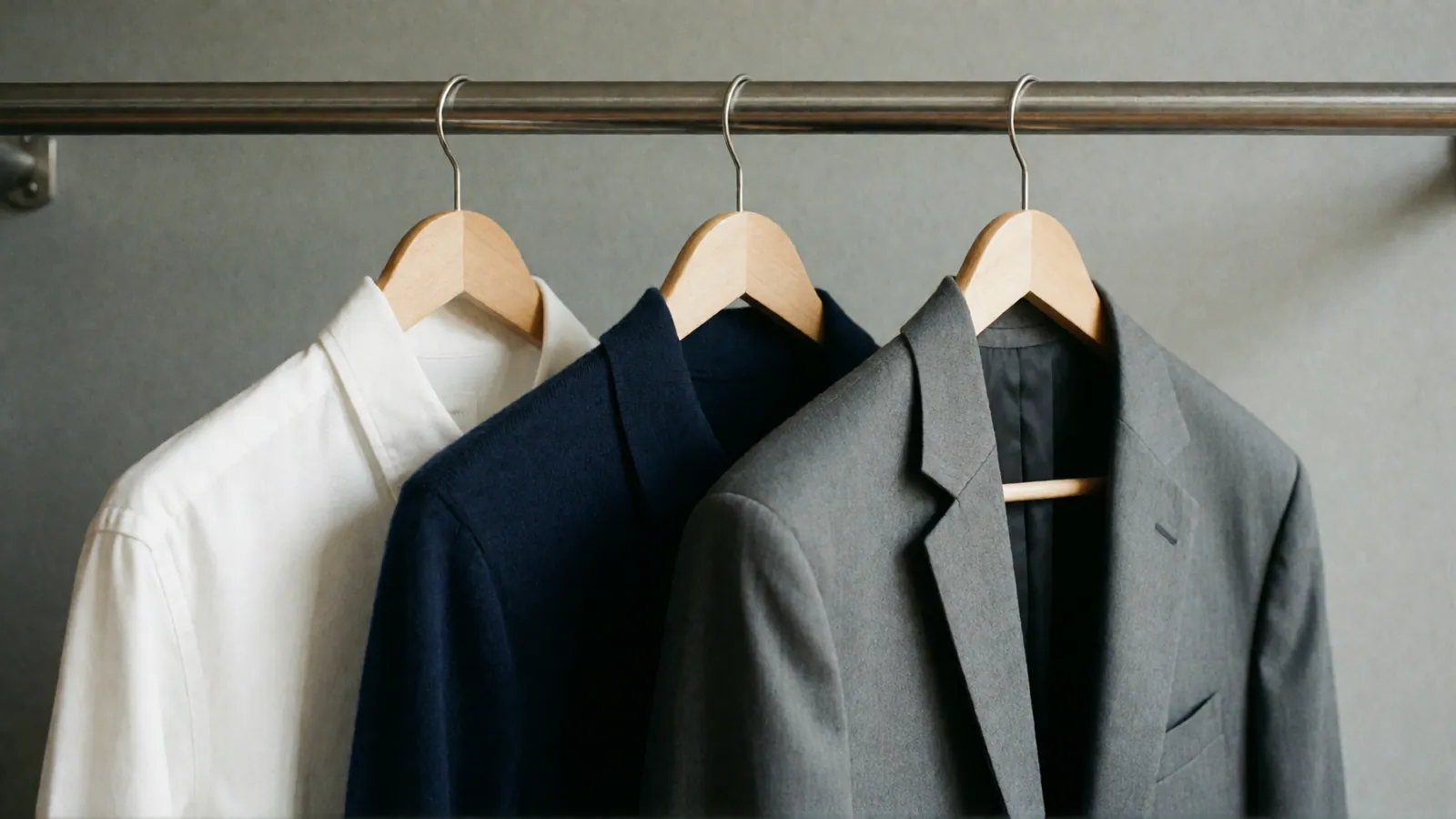
Creases show more than you expect in soft light, and a crease is quicker to steam than to retouch. Bring every look on its own hanger rather than folded in a bag: the studio has a clothes rail, a steamer and a changing room with a mirror, and a few minutes there at the start save far more than they cost.
A jacket is usually photographed buttoned when you stand and open when you sit, and a jacket that has to be held closed will pull. Check it in the mirror with your arms folded, because at some point you will be asked to fold them.
The second look matters more than the first
How many looks you have is set by the session. Thirty minutes is one look; an hour is three looks; an actor's session, an hour and a half, is four looks.
| Session | Looks | Retouched, included | Each one more |
|---|---|---|---|
| Headshot, thirty minutes | One | Two | $40 |
| Headshot session, an hour | Three | Four | $40 |
| Actor headshots, an hour and a half | Four | Five | $40 |
A look is a change of top, and a useful change is more than a change of color. The first look is the one you would wear to the meeting the photograph is for, and it is usually right. The second is where a set of headshots gets its range: if the first is a dark jacket, the second is a lighter shirt without one; if the first is formal, the second is what you wear on an ordinary working day. Two navy shirts are one look photographed twice.
A third look is best spent on the photograph you did not know you needed: the speaker's bio, the book jacket, the page where colleagues look like themselves. An actor's looks work differently again, because casting reads a headshot as a type — the parts you are sent out for most, the parts you want, and one look for each.
Even for thirty minutes, bring a second top. It is the spare if the first turns out too close to the backdrop, and it costs nothing to leave on the rail.
Glasses
If you wear glasses every day, wear them in the photographs. They are part of how people recognize you, and recognizing you is what a headshot is for. Reflections are handled by moving the light or tilting the frames a few degrees, which is why you may be asked to lower your chin or to push the glasses a little higher on your nose.
An anti-reflective coating makes that easier. Lenses that darken in daylight can tint beside a big window, and the studio's light comes from a wall of windows facing north; if yours do, bring a clear pair if you have one.
If you want some frames without them, take them off a few minutes beforehand so the marks on the bridge of your nose can fade. And bring a cloth: a fingerprint on a lens is the one thing no amount of light hides.
The week before, and the morning of
A haircut looks its best about a week after it happens, so book it for the week before, not the day before. A beard is best trimmed a few days ahead and tidied on the morning; a clean shave is best done that morning, with the razor you always use.
Wear your makeup the way you wear it to work, a shade more matte: shine is the first thing light finds, and powder or blotting papers deal with it during the session. This is not the week for a new skin product, a new hair color or anything whose effect you have not already seen on yourself.
Hands appear in more headshots than people expect — a hand at the collar, arms folded — so clean, short nails are worth a minute. Sleep, water and an ordinary breakfast show in a face more than anything in the bag.
What goes in the bag, in the order it gets used
- What the photograph is for — a company page, a speaker's bio, casting — because the light and the crop are chosen for it
- Every look on its own hanger, not folded; the studio has a clothes rail, a steamer and a changing room with a mirror
- A lint roller, used on each look before it goes on, and again on a dark jacket under the light
- A comb or a brush, hair ties and a few pins, for the hair that moves between looks
- Powder or blotting papers, and lip balm
- Your glasses and a cloth, and a clear pair if your lenses darken in daylight
- A photograph you are matching, if there is one — last year's headshot, or the team page you are joining
- Water
If you are joining a team the studio has photographed, say so when you book. Every lighting set-up is written down — where each light stood and how high — so a new photograph can sit beside the others without anybody noticing. For a whole team at once, the studio sets up in your own meeting room; that is on the team headshots page.
After the session
Proofs arrive in a private gallery within three working days, and you choose which of them are retouched. Two are included in thirty minutes, four in an hour and five in an hour and a half; each one more is $40. The retouched photographs follow within ten working days of your choosing.
A headshot's license covers your own professional use: your employer's website and staff pages, your professional profiles, a speaker's bio, press and business cards. Advertising is a commercial license. What that covers, and what it does not, is on the usage rights page.
Every session's fee, and who photographs it, is on the headshots page; the times that are actually free are on the booking calendar.
Book a session, or check a date
Sessions are booked straight from the calendar, and a wedding date is held for seven days while you read the agreement. Nothing is paid on this website, at any step.